Phoenix Is the Sun Belt's Last Migration Stronghold: Why Domestic Inflows Grew While Peers Retreated
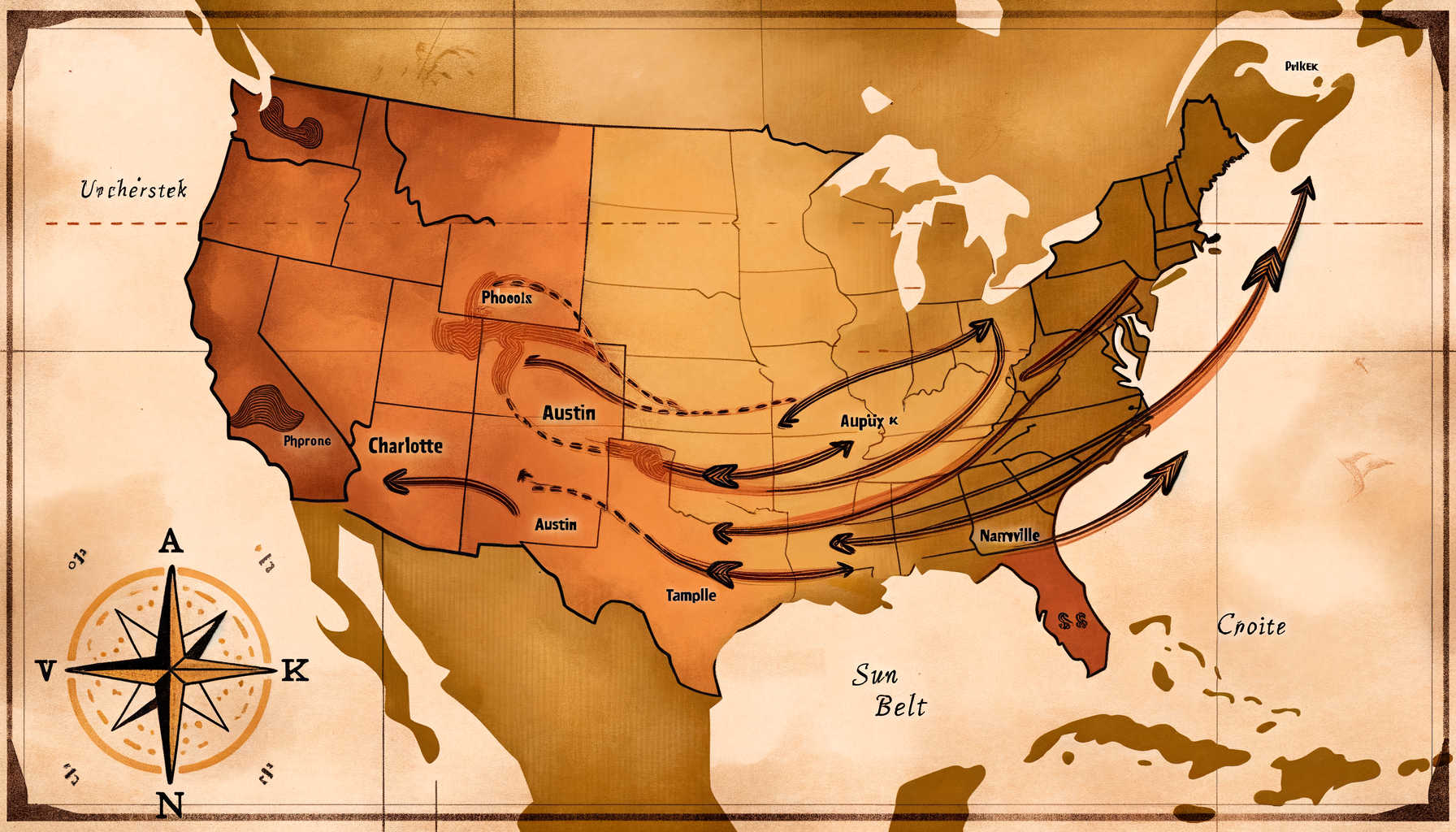
Over the 12 months ending July 2024, every major narrative about the Sun Belt migration trade ran in one direction: retreat. Tampa posted the steepest domestic migration decline of any of the 50 most populous U.S. metros. Florida's statewide domestic inflow fell from 314,000 in 2022 to approximately 64,000 in the most recent Census estimates — an 80% decline from its pandemic peak. Austin and other once-dominant Texas metros joined the slowdown. Phoenix did not.
Per Redfin's analysis of Census Vintage 2024 data, Phoenix's net domestic inflow grew from 19,378 to 21,364 — making it the only major Sun Belt metro to record a YoY increase in domestic migration. Maricopa County, which encompasses the metro, added 57,471 people total, ranking third nationally in county-level numeric gain, per the U.S. Census Bureau's Vintage 2024 Population Estimates released March 2025. The Phoenix metro as a whole gained nearly 85,000 people between 2023 and 2024.
For investors and market analysts tracking Sun Belt demand-side fundamentals, that divergence deserves a structural explanation — not just a footnote.
Tampa's Collapse Sets the Baseline
Tampa's 2024 number makes Phoenix's look sharper by contrast. According to Redfin, Tampa posted a net inflow of just over 10,000 residents in 2024 — less than one-third the 35,000-person net inflow recorded the year before, marking the biggest domestic migration slowdown among the 50 most populous U.S. metros. Rising housing costs eroded the affordability premium that drove the pandemic surge, while back-to-back hurricane seasons layered on insurance friction that made relocation calculus increasingly hostile.
Redfin Premier agent Bryan Carnaggio put it plainly: "People used to move to Florida partly because they could get a deal. Now, people can't afford to move here."
Several Sun Belt metros that attracted pandemic-era migrants have since seen significant price appreciation, compressing the affordability advantage that drew people in the first place. For Florida markets specifically, Redfin reported that high-flood-risk areas across the U.S. saw a net domestic outflow of 29,027 people in 2024 — the first such reversal since 2019.
Phoenix carries none of that insurance liability. The metro sits in a low-flood, low-wildfire-severity footprint relative to Gulf Coast peers, and its cost structure — while no longer cheap by historical standards — remains meaningfully below the high-cost coastal metros that still feed its inbound migration pipeline.
The Structural Case Behind the Number
Phoenix's 21,364 domestic net inflow sits inside a broader population gain of nearly 85,000 people. The balance came from international migration and natural increase — per Axios's analysis of the same Census estimates, the metro's 2023–2024 growth broke down as approximately 14,500 from natural change, around 21,000 from domestic moves, and nearly 49,000 from international newcomers.
That composition matters. Domestic migrants tend to skew toward employed, middle- to upper-income households capable of qualifying for mortgages — exactly the cohort that drives resale and new construction absorption. IRS Statistics of Income data covering 2019–2023 show Arizona captured approximately $3 billion in net adjusted gross income inflows from interstate moves over that period, consistent with a high-earning domestic mover profile.
The economic base underpinning those decisions has grown more durable. TSMC is scaling its Arizona investment to $65 billion across multiple fabrication facilities in Phoenix, with fabs expected to ultimately employ over 6,000 workers. Per CBRE's 2025 Scoring Tech Talent report, Phoenix ranked 20th overall among North American tech markets, with its tech talent labor pool growing 5.6% from 2021 to 2024 and exceeding 102,000 professionals. Arizona's unemployment rate held at 3.6% in 2024, per BLS data.
A diversified job base — spanning semiconductors, healthcare, financial services, and logistics — removes the single-sector fragility that has hurt metros like Austin, whose pandemic boom was concentrated in tech and exposed when that sector pulled back post-2022.
Affordability Still Holds, Relatively
The picture is nuanced. Phoenix's median listing price stands at $496,900, down 4.4% YoY — a correction from pandemic peaks, not a distress signal. Active listings have reached 19,889 at 2.3 months of supply, and the average home sits on market for 54 days. Buyers have leverage they lacked in 2021 and 2022. But 2.3 months of supply is a long way from the eight-month overhang that has developed in Austin and Tampa.
The YoY price decline is the point worth holding. Markets where prices are pulling back modestly while net domestic inflow is rising represent a distinctive setup: demand-side replenishment coinciding with a price correction, rather than both deteriorating together. That's the regime Phoenix is currently running.
Relative to the coastal metros that still generate outbound movers — California, New York, the Pacific Northwest — Phoenix's cost profile retains a measurable gap. Arizona also operates under a low flat income tax structure, a meaningful differentiator for the high-income households the IRS data shows are disproportionately driving Sun Belt migration flows.
Phoenix's Demand Floor Against a Rising Inventory Count
A net domestic inflow of 21,364 represents the delta between arrivals and departures — the pure demand increment from domestic migration alone, before international migration and natural increase are added. Against a market carrying 19,889 active listings at 2.3 months of supply, that sustained demand-side pressure limits how far the inventory correction can run.
George Hammond, director of the Economic and Business Research Center at the University of Arizona, noted in a March 2025 Axios report that population growth "typically juices employment and the economy," adding that newcomers generate downstream jobs in construction, retail, and tourism. The feedback loop matters: migration drives employment, which attracts more migration.
The question the data raises for 2025 and beyond is whether this holds. Census Vintage 2025 data shows the average metro area growth rate nationally fell from 1.1% in 2024 to 0.6% in 2025, driven largely by a 54% decline in net international migration — from approximately 2.7 million to 1.3 million — as federal immigration enforcement tightened. Phoenix and Charlotte were among the metros that still topped the list of absolute numeric gainers despite the broader slowdown, per the Census Bureau's Vintage 2025 release.
The data shows a structural divergence. Phoenix's domestic migration advantage is a separate signal from international inflow — driven by workers and households making deliberate location choices and choosing Phoenix over its Sun Belt peers with increasing consistency.
For investors watching the Sun Belt, the gap between Phoenix and the Gulf Coast metros is now wide enough to treat as structural, not cyclical. Demand-side replenishment is holding; inventory is elevated but not distressed; and the employment base is broadening rather than concentrating. The risk scenario is a meaningful acceleration in new supply — Phoenix's construction pipeline has historically been responsive — but at 2.3 months, the market still has significant room to absorb before that becomes the dominant variable. Redfin's monthly migration updates and the Phoenix active listings series on FRED will provide the earliest read on whether the Q1 2025 domestic inflow trend is holding.