DFW Job Market 2026: Payroll Rebound, Wage Slowdown, and What It Means for Relocators
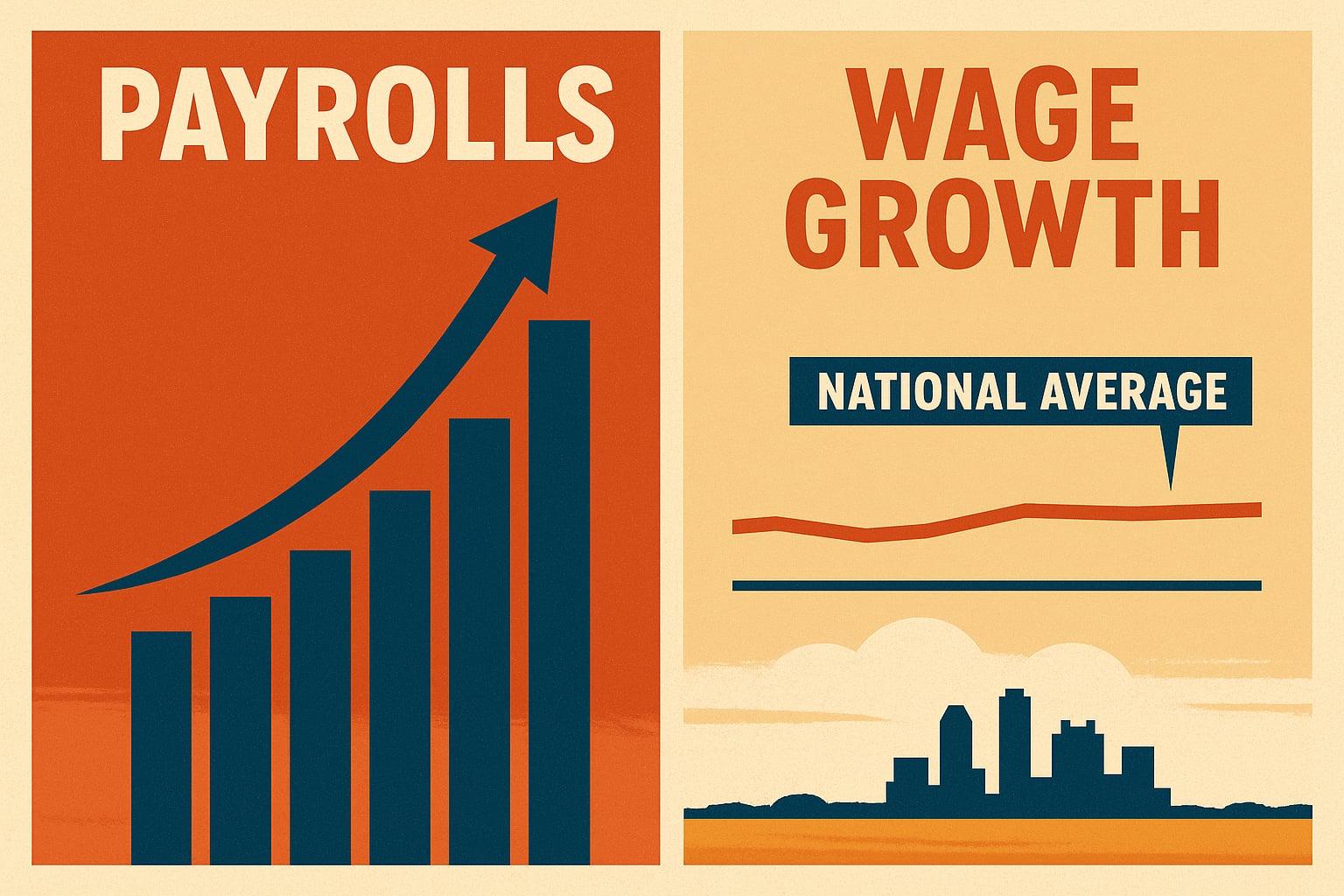
The BLS January 2026 data for Dallas-Fort Worth tells two stories that most market watchers have kept separate. Read together, they reframe the metro's employment picture in a way that matters for both employers and professionals weighing a relocation.
Payrolls snapped back sharply after a late-2025 soft patch. Wage growth, meanwhile, decelerated to the second-slowest pace among major U.S. metros. Both trends are real. Neither cancels the other out.
The January Rebound in Context
DFW added 41,900 nonfarm payroll jobs year-over-year in January 2026, a 1.0% gain, per the BLS Dallas-Fort Worth Area Economic Summary. That follows December 2025's 14,200 YoY reading — the metro's weakest since 2021. February 2026 pulled back to 24,200 jobs (0.6%), still well above the late-2025 low, suggesting January's print wasn't a one-month anomaly.
Two consecutive months above the December floor matter. One more confirming print would make a stronger case for a genuine recovery trend rather than a seasonal bounce. The data is encouraging; it is not yet conclusive.
The December slump had been driven by contraction in Professional & Business Services and soft readings across most cyclical sectors. January's rebound was broad enough to reverse that narrative — though not uniformly.
Construction Leads, Professional Services Flip, Information Stays Negative
Mining, Logging, and Construction posted the strongest sectoral gain at +4.4%, adding 11,100 jobs YoY per the BLS Current Employment Statistics. That pace is consistent with the infrastructure buildout supporting DFW's data center and corporate campus pipeline. DataBank's $2 billion construction loan for a data center campus in Red Oak, fully leased before a single building opens, is representative of what is pulling those workers onto job sites.
The more analytically interesting move was in Professional & Business Services. The sector swung from losing 14,300 positions in the November 2025 reading (YoY) to posting +12,500 jobs and +1.6% growth in January 2026. That is a significant directional shift in a sector that includes accounting, finance, consulting, and administrative roles. Whether January marked a genuine inflection or a one-period correction is the question the next two BLS releases will answer.
Information continued to contract, down 1.6% YoY. Tech hiring headwinds have persisted in DFW despite the metro's broader recovery. The Texas Stock Exchange's confirmed lease at the Bank of America Tower at Parkside in Uptown, targeting a July 2026 trading launch, adds a new financial-services vector to DFW's employment base. That is a 2026-and-beyond story for the Information and Financial Activities sectors, not a January 2026 driver.
The unemployment rate held at 4.1% in February 2026, unchanged from a year earlier per BLS Local Area Unemployment Statistics — a signal that the labor market is absorbing the rebound without meaningfully tightening.
Wage Deceleration: The Number Employers Are Watching
The BLS Employment Cost Index released April 30, 2026 shows compensation costs for private industry workers in DFW rose 2.3% for the year ending March 2026. A year prior, that figure was 4.4%. Wages and salaries alone grew just 1.8% in Dallas, compared to 3.4% nationally, per the BLS Employment Cost Index for the Dallas Metropolitan Area, March 2026. Among the 15 largest U.S. metros tracked by BLS, only Houston posted slower compensation cost growth than Dallas.
That 160-basis-point gap between DFW wage growth and the national rate is the single most consequential number in this data set for employers.
For companies recruiting from coastal markets — where workers have been repricing their labor at national or above-national rates — the DFW wage environment offers a structural advantage. Candidates relocating from San Francisco, Seattle, or New York are accustomed to negotiating against a 3% to 4% baseline. Dallas enters those conversations at 1.8%.
Wage compression is giving employers room to operate — a structural advantage the metro's recruiting environment has rarely offered at this scale.
The Real Purchasing Power Case
For the relocating worker, the wage deceleration headline needs to be paired with the price side of the ledger. DFW consumer prices fell 0.3% for the 12 months ending January 2026, per the BLS Consumer Price Index for the Dallas-Fort Worth-Arlington area. Nationally, prices rose 2.4% over the same period. That makes DFW's real purchasing power position considerably stronger than the nominal wage gap implies.
A worker accepting a DFW offer at 1.8% nominal wage growth is doing so in a market where the goods and services basket is modestly cheaper than a year ago. Coastal comparables are facing 2% to 3% cost-of-living inflation against similar or modestly higher nominal wage growth. The DFW real wage picture, while not spectacular, is more competitive than the headline 1.8% suggests.
The practical implication for salary negotiation: candidates entering DFW offers should benchmark against metro-specific BLS Occupational Employment and Wage Statistics data, not national ECI figures. Using the national 3.4% as a reference point overstates what the local market is delivering.
Corporate Inflows and the Demand Signal Behind the Data
Payroll readings don't happen in isolation. DFW captured 11 interstate or international corporate headquarters relocations in 2025, leading all U.S. metros per CBRE's 2026 Shifting Landscape of Headquarters Relocations report. From 2018 to 2024, the metro attracted 100 new headquarters — more than any other U.S. metro.
That pipeline of relocating companies brings demand for exactly the Professional & Business Services profiles that appear to have returned to growth in January 2026. The question is whether that demand sustains over multiple quarters or front-loads hiring in ways that make sector readings volatile near each corporate campus opening.
Population growth adds a backdrop worth noting. DFW added 123,557 residents in the most recent Census Bureau annual estimates, bringing the metro to approximately 8.5 million. The growth rate decelerated meaningfully year-over-year, driven primarily by a significant drop in international migration. A slower-growing labor supply against continued corporate inflows would, mechanically, tighten the market — which makes the current wage deceleration more notable, not less. Supply is cooling and wages still aren't accelerating.
That combination of rising corporate demand, decelerating labor supply growth, and wages running below national norms is the tension the next six months of BLS data will resolve. Either wages start to move toward the national rate as the tightening works through, or the metro's structural cost advantages continue to attract employers faster than workers, keeping the gap open. History in DFW favors the latter.
Primary sources: BLS Dallas-Fort Worth Area Economic Summary (updated April 16, 2026); BLS Employment Cost Index for the Dallas Metropolitan Area, March 2026 (released April 30, 2026); BLS Consumer Price Index, Dallas-Fort Worth-Arlington area (March 2026); BLS Local Area Unemployment Statistics (published April 29, 2026); CBRE Shifting Landscape of Headquarters Relocations, April 2026; U.S. Census Bureau population estimates, March 2026. Subscribe to the SunBeltPulse data brief for monthly DFW employment updates.
This article was researched and drafted with AI assistance, fact-checked, and reviewed by an editor before publication — see our Editorial Standards. It is general information about real estate markets, not financial, investment, legal, or real estate advice; consult a licensed professional before acting. See our full disclosure.
More market analysis
Houston Added 44,700 Jobs in a Year, More Than Any U.S. Metro: A Relocator's Guide
5 min read
Houston vs. Dallas Cost of Living 2026: Jobs, Insurance, and What Relocators Actually Pay
4 min read
Dallas-Fort Worth Tech Jobs 2026: 11,000 New Roles, $761M AI Investment, and What It Means for Relocators
4 min read
Considering a move? Explore the full Dallas-Fort Worth market data — home prices, rents, jobs, permits, and population trends.
Beyond the calculator: see our full relocation toolkit — movers, agents, insurance, and city-test rentals.