Charlotte's Job Market: 14,900 New Jobs and What It Means for Relocators
If you and your partner are weighing a move to Charlotte, the job numbers are a reasonable place to start your case.
Nonfarm employment in the Charlotte metro grew approximately 1.1% over the 12 months ending April 2026, adding an estimated 14,900 net new jobs (Source: Mark Vitner, Piedmont Crescent Capital, NAIOP Charlotte mid-year economic outlook, June 3, 2026). Charlotte's job growth continues to run above the national pace, according to Vitner's mid-year outlook. That's a meaningful signal for anyone trying to decide whether a Charlotte move makes career and financial sense.
Note: The figure above reflects data as presented in the June 2026 mid-year report, which postdates a BLS annual benchmark revision; the revised trailing-12-month figure as of June 2026 is lower than estimates reported earlier in the year.
The Sectors Behind the Growth
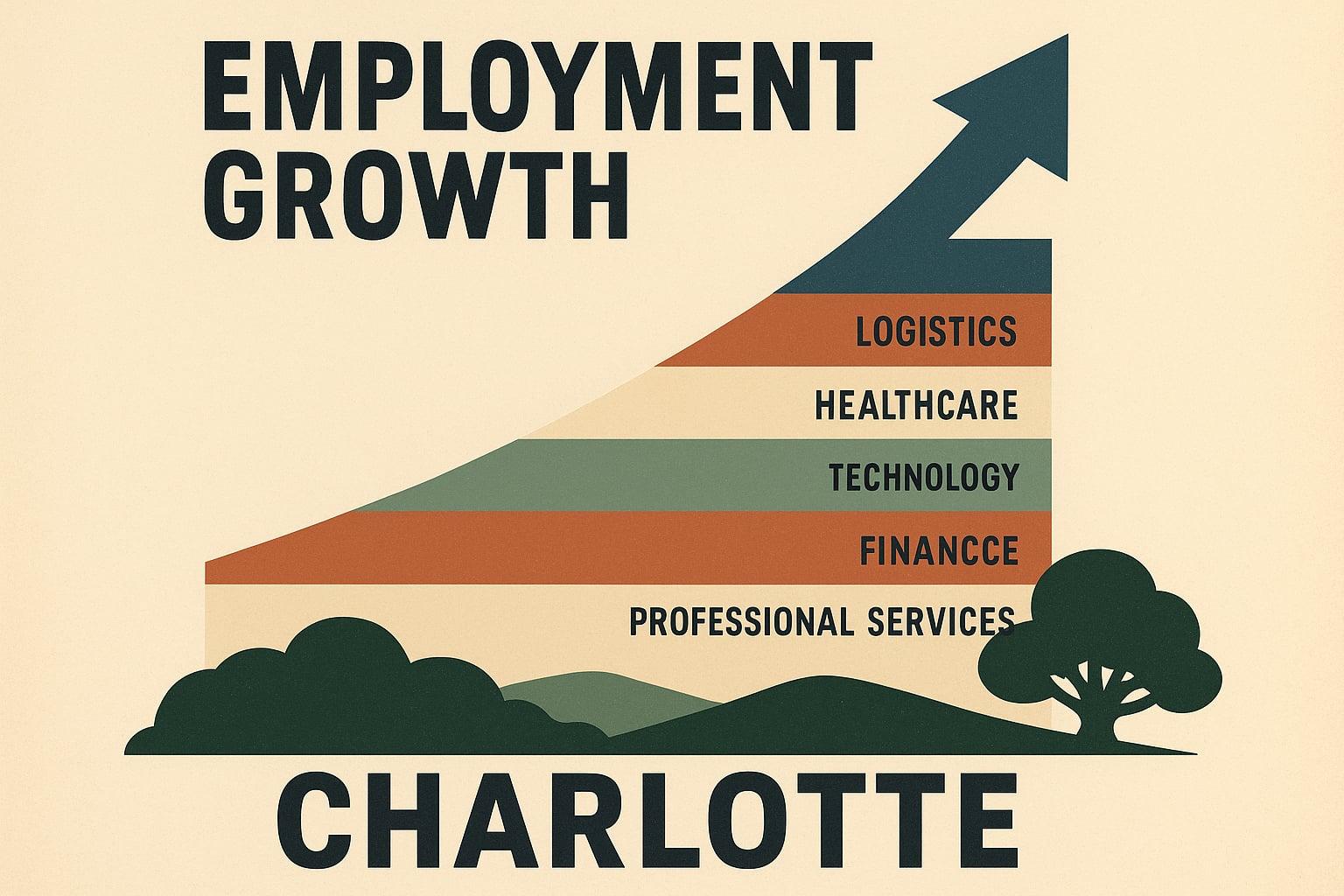
Healthcare, construction, and professional services are adding jobs steadily in Charlotte's current cycle. Financial activities remain a structural anchor. Charlotte's business and financial operations sector commands above-average wages nationally, reflecting the city's role as the second-largest banking centre in the United States behind New York.
The region is anchored by major employers including Bank of America, Wells Fargo, Truist, Atrium Health, Novant Health, and Duke Energy — and recent commitments include Sumitomo Mitsui Banking Corporation choosing Charlotte for its second US headquarters, committing a major investment commitment (Source: NC Governor's office / EDPNC, April 2026), along with Citigroup Technology Inc., which announced a $16.1 million investment and 510 jobs in Charlotte (Source: NC Commerce / NC Governor's office, July 8, 2025).
For the career mover in the room: these aren't one-off hires. The banking and fintech pipeline runs deep enough to support lateral moves, promotions, and specialisation over time — not just an entry point.
Healthcare runs parallel: Atrium Health (now part of Advocate Health) and Novant Health are Charlotte's two dominant health systems and among the city's largest employers.
The Unemployment Picture
The Charlotte metro unemployment rate was 3.6% in June 2026 (Source: BLS Local Area Unemployment Statistics, June 2026, not seasonally adjusted) — well below the national average of 4.2%.
That tracks with the Charlotte housing market data and broader in-migration trends.
A tight labour market means less friction for job-seekers relocating into established fields, but it also means more competition for housing. Both are important to understand before you move.
The State-Level Tailwind
Charlotte isn't growing in a vacuum. Charlotte's revised job growth of 1.1% over the 12 months ending April 2026 ran roughly twice the national pace, according to Vitner's mid-year outlook, even as hiring cooled across most of the country.
Economist Mark Vitner of Piedmont Crescent Capital released a mid-year economic outlook showing Charlotte on pace for 3.2% real GDP growth in 2026, with the metro projected to average 2.8% to 3% annual growth through 2030 — well above the projected 2.3% U.S. pace (Source: Piedmont Crescent Capital / NAIOP Charlotte, June 2026).
UNC Charlotte's Belk College of Business initially projected North Carolina's economy to add 80,800 net jobs in 2026; a Q1 2026 revision lowered that figure to 65,100, a 1.6% employment increase, with growth across all 14 nonagricultural sectors (Source: UNC Charlotte Belk College of Business, NC Economic Forecast, Q1 2026 edition).
Where Jobs and Neighbourhoods Overlap
Job growth doesn't land evenly across a metro. In Charlotte, the hiring is concentrating along specific corridors, and those corridors are exactly where housing competition is sharpest.
Charlotte's growth corridor, covering neighbourhoods around South End, Ballantyne, and University City, keeps drawing heightened buyer demand, infrastructure investment, and corporate relocation.
For the career mover: South End puts you within the light rail network, steps from fintech offices and creative agencies. University City developed around UNC Charlotte campus, and the Blue Line extension connected it to Uptown, spurring development. Ballantyne anchors south Charlotte's corporate park cluster.
For the family anchor: Ballantyne has grown into a self-contained suburban hub with access to shopping, restaurants, and office parks, and a reputation for relatively low crime and quality schools.
What the Housing Market Reflects
Strong job growth feeds housing demand. Here's what that looks like in Charlotte's current market.
Home values are rising modestly. The FHFA House Price Index for Charlotte stands at 412.4, up 1.5% year over year and 0.3% quarter over quarter (Source: FHFA House Price Index, Q2 2026). The population is growing at 1.88% year over year (Source: Census Bureau Population Estimates, 2025), fast enough to sustain demand pressure in supply-constrained corridors.
On the rental side, the HUD Fair Market Rent for a two-bedroom in the Charlotte metro is $1,686 per month (Source: HUD Fair Market Rents, FY2026). With a 30-year fixed rate at 6.76% (Source: Freddie Mac Primary Mortgage Market Survey, week of September 10, 2026), the buy-vs-rent calculation is worth running carefully before you commit.
Permit activity adds a note of caution. Charlotte authorised 1,289 housing units in July 2026, down 22.8% from the same month a year earlier (Source: Census Bureau Building Permits Survey, July 2026). Monthly permit counts are volatile, but the directional trend suggests new supply isn't keeping pace with demand, which means buyers who wait may not find relief from price pressure.
Making the Call on Charlotte
For the career mover, the data is straightforward: approximately 14,900 net new jobs over the 12 months ending April 2026, in a metro with unemployment at 3.6% (Source: BLS Local Area Unemployment Statistics, June 2026, not seasonally adjusted), anchored by financial services and healthcare employers that hire at multiple career levels.
For the family anchor, the economic stability argument is real. Ballantyne and University City each offer the combination of school access and community amenities that tend to matter most in a relocation with children.
Run the numbers on your specific scenario using a Charlotte mortgage affordability calculator, then book a weekend visit to walk South End and Ballantyne before you decide.
This article was researched and drafted with AI assistance, fact-checked, and reviewed by an editor before publication — see our Editorial Standards. It is general information about real estate markets, not financial, investment, legal, or real estate advice; consult a licensed professional before acting. See our full disclosure.
More market analysis
Charlotte's Corporate Boom: What 3,880 New Jobs Mean for the Housing Market in 2026
4 min read
NC Led Every State in Migration in 2025. Here's What That Means If You're Moving to Raleigh or Charlotte.
4 min read
Charlotte's Hiring Boom: How 2025's Fastest-Growing Large U.S. Metro Is Rewriting Its Housing Story
5 min read
Considering a move? Explore the full Charlotte market data — home prices, rents, jobs, permits, and population trends.
Beyond the calculator: see our full relocation toolkit — movers, agents, insurance, and city-test rentals.