Orlando Added 20,600 Jobs in a Year — and AI Is Just Getting Started
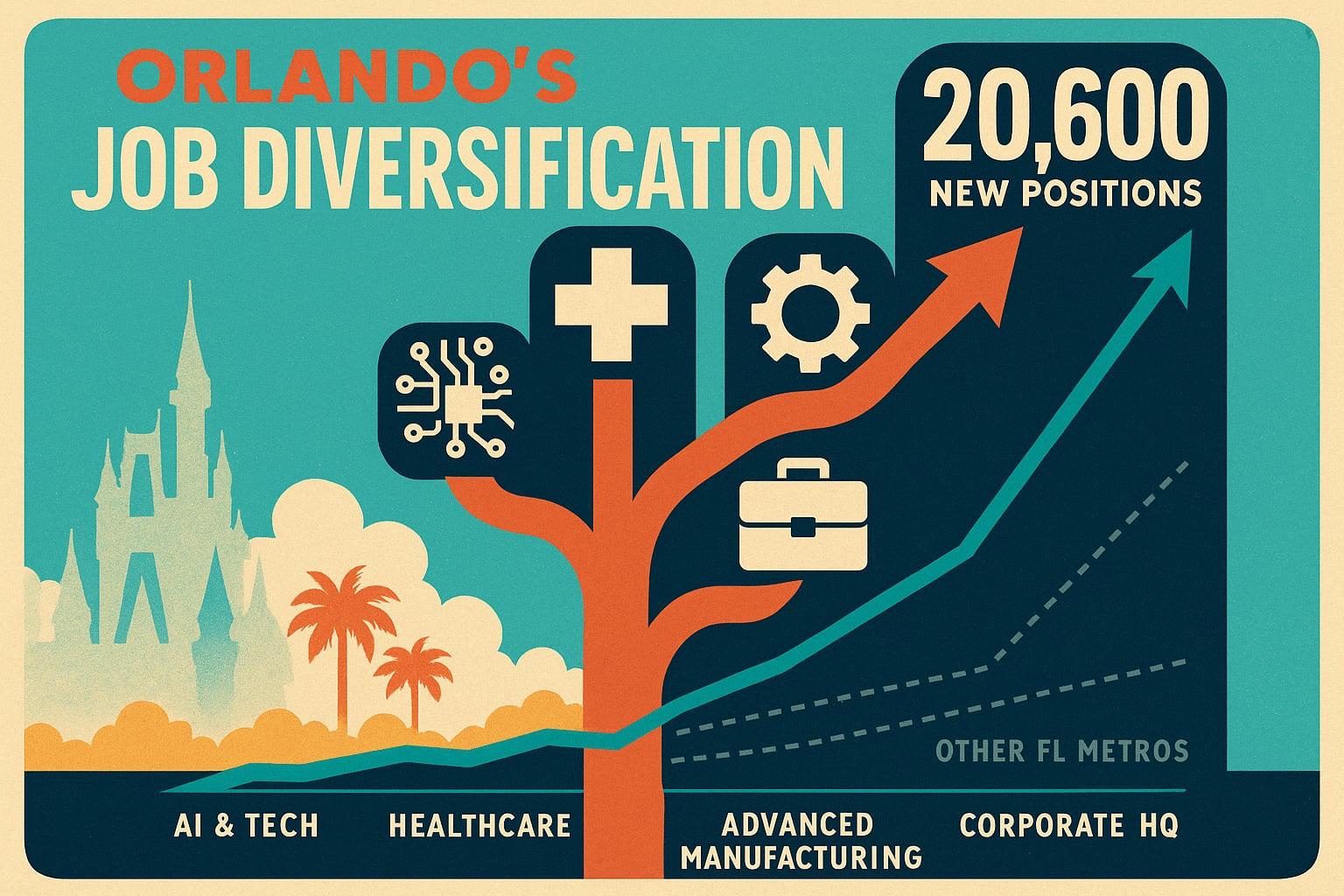
If you're planning a move to Orlando and wondering whether the job market can support your career, the headline number answers it directly: Orlando added 20,600 jobs in the 12 months ending June 2026, outpacing the national growth rate and finishing ahead of every other major Florida metro area.
That's the foundation. But the more interesting story is what kind of jobs are being added.
Orlando Outpaces the Country, Not Just Florida
Orlando's payrolls grew 1.4% year over year at midyear 2026, compared with 0.3% nationally, ranking the metro ahead of all but four of the 30 most populous U.S. regions (Source: Orlando Economic Partnership, "The Orlando Economy at Midyear: 5 Things to Know," July 23, 2026). For a city still associated in many minds with theme parks, that's a meaningful signal.
Context matters here. Orlando averaged 44,300 new jobs per year in the five years leading up to the pandemic (2015–2019) and 43,900 per year in the period immediately following (2022–2024) (Source: Orlando Economic Partnership, April 2026). The current pace is more moderate, but the directional story remains clear: Orlando is growing faster than most of the country and faster than every Florida peer.
Four Sectors, Not One
If you've been burned by a single-industry town before, you'll want to look at how Orlando's growth is distributed. The metro's expansion is concentrated across four distinct pillars: healthcare, technology, hospitality, and logistics. No single sector is carrying the whole load.
Healthcare and education services are a consistent anchor. Leisure and hospitality, the metro's legacy strength, continues adding workers as tourism demand holds. Professional and business services contribute office-based employment. Logistics activity has grown alongside the region's population, which climbed by approximately 37,690 residents in the 12 months ending July 2025, making Orlando the fastest-growing large Florida metro in that period (Source: Census Bureau Population Estimates, 2025).
That population pressure, in turn, supports the healthcare and service sectors in a self-reinforcing loop.
The AI Signal
Here's where the story gets genuinely new. Orlando-area job postings seeking AI skills reached almost 1,900 in June 2026, roughly double the total from a year earlier and about four times the level from two years ago (Source: Orlando Economic Partnership, "The Orlando Economy at Midyear: 5 Things to Know," July 23, 2026).
In February, cyber range and cybersecurity firm SimSpace announced it is relocating its global headquarters to Orlando, anchoring a new AI-testing and cyber-range hub (Source: SimSpace press release, February 4, 2026). A headquarters relocation is a longer commitment than a hiring plan, and it signals that Orlando is attracting corporate investment, not just individual workers.
The Unemployment Number — and What It Actually Means
Unemployment in Orlando sits at 4.6%, not seasonally adjusted (Source: BLS Local Area Unemployment Statistics, June 2026, not seasonally adjusted). That's worth a closer look before you read it as a warning sign. Because this figure is not seasonally adjusted, it typically runs somewhat higher than the seasonally adjusted rate, and June in particular tends to reflect seasonal labor-market patterns.
Unemployment did rise to 4.6% in June, driven partly by aviation-sector layoffs following Spirit Airlines' shutdown in May 2026 and broader softness in retail trade. Both things can be true at once: a metro can add jobs at more than four times the national pace while its unemployment rate ticks up, because Central Florida keeps adding working-age residents faster than most of the country (Source: Orlando Economic Partnership, "The Orlando Economy at Midyear: 5 Things to Know," July 23, 2026).
In other words, the labor pool is expanding along with the job count. That's a different dynamic than a market shedding work.
What the Salary Picture Looks Like
Orlando wages trail the national average. Workers in the Orlando-Kissimmee-Sanford metropolitan area had an average hourly wage of $29.76 in May 2025, compared with $33.54 nationally (Source: BLS Occupational Employment and Wage Statistics, May 2025). That figure is a blended metro-wide average across all occupations and industries; wages in tech, healthcare, and cybersecurity roles skew materially higher and are worth researching separately if those are your target fields.
The gap is real. The offset is cost of living. A two-bedroom apartment runs $1,972 per month at the HUD Fair Market Rent benchmark (Source: HUD Fair Market Rents, FY2026), and home prices have held relatively steady: the FHFA House Price Index for the Orlando metro came in at 457.1, up 0.8% year over year (Source: FHFA House Price Index, Q2 2026). At a 30-year fixed rate of 6.76% (Source: Freddie Mac Primary Mortgage Market Survey, week of September 10, 2026), affordability is a real consideration, but Orlando still compares favorably against higher-cost Florida metros.
For a fuller breakdown of how Orlando stacks up on taxes, utilities, and groceries, see the Orlando cost of living breakdown (coming soon).
Neighbourhoods Absorbing the Growth
Office space absorption in Orlando posted its strongest year-to-date net absorption in five years through Q2 2026 (Source: Orlando Economic Partnership, "The Orlando Economy at Midyear: 5 Things to Know," July 23, 2026). That absorption is concentrated in employment corridors rather than spread uniformly across the metro. Workers moving to Orlando for healthcare roles tend to cluster near the medical district; tech and defense hiring pulls toward the area around UCF and Lake Nona; logistics workers anchor in distribution corridors near the interchange network.
Building permits for new housing came in at 2,008 units authorized in July 2026, down 3.6% from the same month a year earlier (Source: Census Bureau Building Permits Survey, July 2026). Supply is still coming online, but monthly permit data is volatile, so a single month's dip isn't a trend call.
Making the Move Decision
Orlando's job market in 2026 rewards relocators who have skills in healthcare, technology, or logistics more than those entering hospitality, where wages remain the thinnest. If your field overlaps with the AI and cybersecurity expansion underway, the timing is arguably better than it's been in years.
Start by checking which employment corridor aligns with your industry, then use the Orlando housing market data to see where inventory and pricing sit in that specific submarket.
This article was researched and drafted with AI assistance, fact-checked, and reviewed by an editor before publication — see our Editorial Standards. It is general information about real estate markets, not financial, investment, legal, or real estate advice; consult a licensed professional before acting. See our full disclosure.
More market analysis
Atlanta's Tech and Data-Centre Boom: 25,300 New Jobs, $35.2B Investment, and What It Means for Relocators
5 min read
Austin's 2026 Tech Job Boom: AI, Semiconductors, and What It Means for Relocators
5 min read
Dallas-Fort Worth Tech Jobs 2026: 11,000 New Roles, $761M AI Investment, and What It Means for Relocators
4 min read
Considering a move? Explore the full Orlando market data — home prices, rents, jobs, permits, and population trends.
Beyond the calculator: see our full relocation toolkit — movers, agents, insurance, and city-test rentals.