Moving to Orlando in 2026: Florida's Fastest-Growing Metro Has a Population Story Worth Reading
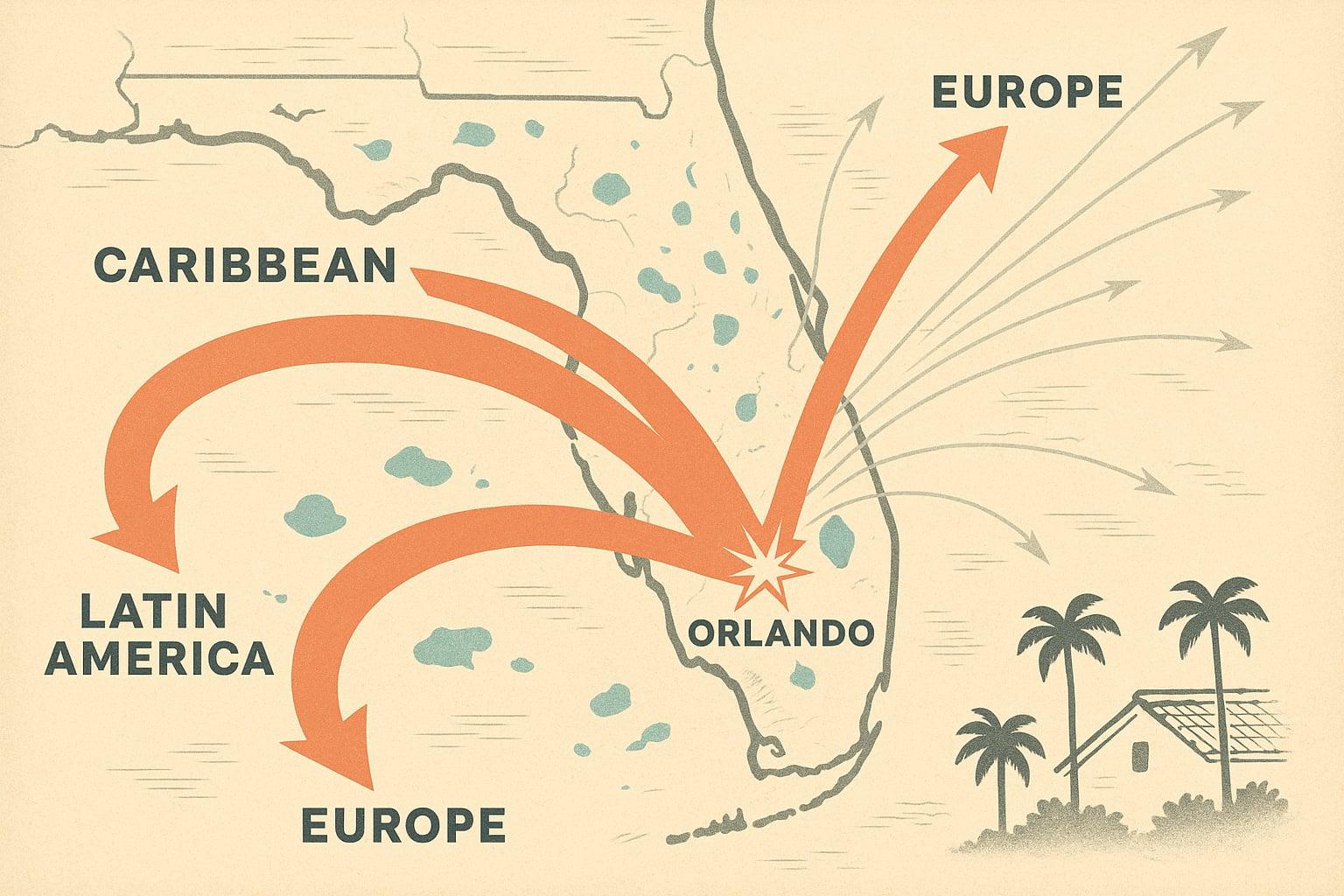
If you're weighing a move to Orlando in 2026, the headline number is compelling: the metro added 37,690 residents in the year ending July 2025, making it Florida's fastest-growing region and the 10th-largest numeric gain among all U.S. metros. But the story underneath that number is the one that actually matters to a buyer.
The Growth Engine Has Switched
Orlando's raw growth figure looks strong, but its composition has fundamentally changed. International migration was the dominant driver of the total gain, more than offsetting a net domestic outflow. That structural shift — more Americans leaving Orlando than arriving from elsewhere in the U.S. — is worth understanding before you sign a purchase contract.
International migration fell 36% from 2024 (Source: Orlando Economic Partnership / U.S. Census Bureau, March 2026), which already signals a decelerating pipeline. At the national level, net international migration came in at approximately 2.8 million for the year ending July 2024, per the Vintage 2024 estimates released December 2024 — a figure subsequently revised to approximately 2.7 million in the January 2026 Vintage 2025 release. Available data indicate that figure has declined substantially in 2025, and the Census Bureau's own projections suggest it could fall further in 2026 under current policy trends.
With natural change contributing less to growth than it once did, metros that lack positive net domestic migration are heavily dependent on international migration for population growth. Orlando is precisely that kind of market right now.
What the Policy Risk Means for Buyers
Federal immigration policy has tightened considerably since 2025. If international arrivals continue to decline, Orlando's population growth engine could slow faster than its housing market has priced in. Orlando's population grew 1.3% in 2025 — below the 2.0% recorded in 2024 (Source: Orlando Economic Partnership / U.S. Census Bureau, March 2026) — and the trajectory is pointing downward, not up.
For a buyer evaluating long-term demand, that context matters. Growth is not gone — since the 2020 Census, Orlando has added 284,300 residents total, with almost 65% of that growth coming from international migration (Source: Orlando Economic Partnership / U.S. Census Bureau, March 2026). But a metro that has built its demand story on international inflows carries more policy sensitivity than one driven by domestic job-seekers.
Pair that context with the Tampa domestic migration collapse that played out just across I-4, and the pattern becomes clearer: Florida's big metros are navigating the same structural transition simultaneously.
Where New Residents Are Actually Landing
Across the four-county MSA — Lake, Orange, Osceola, and Seminole — overall population grew, according to the Orlando Economic Partnership, though growth was uneven by county. Osceola (Kissimmee) and Lake counties have absorbed much of the migration pressure, which has kept prices in those corridors more accessible than the metro average.
Kissimmee and Celebration carry median prices that remain below the metro average, with slightly longer average days on market. If you're entering near the median, those corridors are where your dollar goes furthest. Lake Nona, driven by its medical-city corridor and continued employer growth in southeast Orlando, commands a notable premium above the Kissimmee corridor.
Inventory has rebuilt materially. As of June 2026, active listings across the Orlando market were up roughly 16–18% year over year — a decade-plus high, per the Orlando Regional REALTOR® Association. Buyers entering this market have more homes to choose from than at any point in recent years.
On the price side, the FHFA House Price Index for Orlando has flattened to +0.8% year over year as of Q2 2026, and Census Bureau building permits data shows ongoing new supply authorization — a supply response that is now visibly easing the demand dynamic.
The Lifestyle Case (For the Other Half of This Decision)
If your partner is asking why Orlando specifically, the amenity data makes an honest answer easy. WalletHub's 2026 Best & Worst Cities for Recreation ranked Orlando the second-best large city in America (Source: WalletHub, July 2026). The site noted that "the best cities for recreation have a wide variety of indoor and outdoor activities that can help people of all ages stay entertained and active" — and Orlando ranks at the top of the country for sports venues per capita.
WalletHub also ranked Orlando 11th for recreation center availability and 12th for the percentage of city land designated as parkland (Source: WalletHub, July 2026). For a city best known for theme parks, the everyday livability numbers are quietly impressive.
On the cost side, HUD Fair Market Rent data puts a two-bedroom apartment at $1,972 per month — above the national median but reasonable for a metro with this amenity footprint. Florida homeowners insurance remains a real line item, with statewide average premiums elevated even after recent tort-reform rate reductions. Budget for it. For the full cost-of-living picture, see the Orlando cost-of-living breakdown, and track permit and price trends on the Orlando housing market data page.
Demand Risk vs. Livability: What Each Partner Needs to Know
For the data-driven partner: Orlando's growth numbers are real, but they now depend almost entirely on international migration — a flow that has already decelerated and carries ongoing policy risk. The FHFA price index has flattened to +0.8% year over year (Q2 2026), permits are roughly flat to slightly down year-over-year, and unemployment sits at 4.6% on a not-seasonally-adjusted basis (Source: BLS / FRED ORLA712URN, June 2026), so the fundamentals are cooling but not broken. But you're buying into a market with a concentration risk in its demand driver. Kissimmee and the Lake corridor offer the best price-to-demand ratio right now, and with inventory at a decade-plus high, 2026 offers more choice and less urgency than buyers have seen in years — you can afford to be selective.
For the lifestyle partner: the parks, recreation, and entertainment infrastructure here is nationally ranked and genuinely accessible day-to-day — not just for tourists. The climate, the food scene, and the proximity to both coasts make the quality-of-life argument easy to make.
If you want to stress-test the numbers before you move, run your mortgage payment at current rates with a calculator, then book a long weekend in Lake Nona or Kissimmee to test the neighbourhoods in person. That two-step process — verify the math, then verify the feel — is the fastest way to settle the decision.
This article was researched and drafted with AI assistance, fact-checked, and reviewed by an editor before publication — see our Editorial Standards. It is general information about real estate markets, not financial, investment, legal, or real estate advice; consult a licensed professional before acting. See our full disclosure.
Considering a move? Explore the full Orlando market data — home prices, rents, jobs, permits, and population trends.
Beyond the calculator: see our full relocation toolkit — movers, agents, insurance, and city-test rentals.