Pinellas County Is Losing Residents Faster Than Almost Anywhere in America — Here's What Tampa Buyers Need to Know
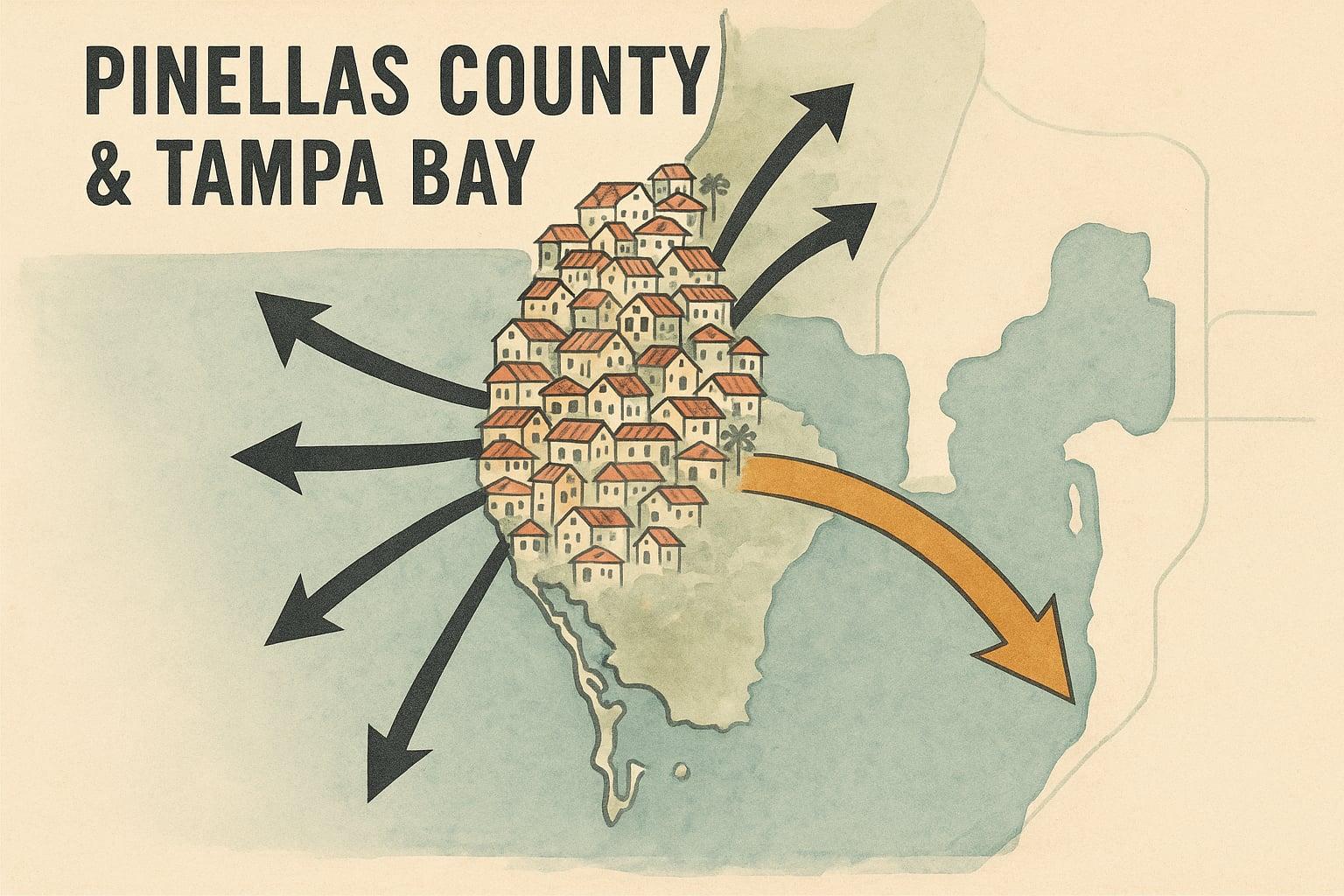
If you're weighing a move to the Tampa Bay area, the headline number out of Pinellas County will catch your eye: the county just posted the second-largest population loss of any county in the United States. Keep reading before you close the tab. That statistic is both a warning and, depending on where you buy, a genuine opportunity.
The Number Behind the Headline
U.S. Census data shows Pinellas lost 11,834 residents from July 2024 to July 2025, falling from 960,397 to 948,563 — second only to Los Angeles County nationwide.
That's not a rounding error. It's also not the whole story.
Pinellas relies on migration to grow: deaths outpace births there more than in any other American county (Source: U.S. Census Bureau via WUSF, March 2026). Back-to-back hurricanes Helene and Milton in 2024 accelerated departures that were already underway, and some residents who left cited affordability.
What Priced People Out
The affordability squeeze is real. Florida's median sale price has climbed sharply since the pandemic — Redfin puts the statewide median near $395,000 as of mid-2026 — erasing the value gap that drew movers in the first place.
That shift has thinned the supply of working-age newcomers, the people who fill jobs and drive demand for housing, retail, and services. It matters more in Florida than in most states, because the economy leans on those sectors rather than on high-paying industries that absorb a higher cost of living.
In Tampa Bay, nearly half of households in Pinellas and Hillsborough counties can't cover basic living expenses, according to United Way. The working-age residents priced out of ownership are the ones leaving; higher-income retirees and waterfront buyers largely stay, which is why luxury demand in downtown St. Pete and Tampa holds up even as the broader market softens.
What the Tampa Market Looks Like Right Now
Here's where this gets useful if you're actively looking to buy.
Redfin data for the three months ending May 2026 shows Tampa's median sale price at $443,000, down 1.4% year-over-year, with homes averaging 41 days on market versus 36 a year earlier (Source: Redfin). The market is balanced to slightly buyer-favoring. The FHFA House Price Index for the metro reads 554.5 as of its latest quarterly release (Q4 2024), up 1.9% year-over-year but down 0.9% quarter-over-quarter. The annual trend is flattening.
Single-family prices have slipped modestly year-over-year, while condo and townhouse prices have fallen harder. For budget buyers, that condo softness creates real negotiating room; for single-family buyers on higher ground, conditions are merely balanced.
Pinellas County Commissioner Brian Scott told FOX 13 the dip looks like a reaction to the hurricanes, not a long-term concern, and that projections still point to growth resuming (Source: FOX 13, April 2026).
The Insurance Conversation to Have Before You Buy
This is the number that surprises most relocators.
Florida's average annual home insurance cost hit $8,292 in 2025 — an 18% jump over 2024 — and Insurify projects a further 2% rise to $8,458 by the end of 2026 (Source: Insurify 2026 Insuring the American Homeowner Report). In Tampa, coastal or older properties routinely run well above the state average.
There's a partial offset underway: Citizens Property Insurance, the state's insurer of last resort, has cut rates in recent renewal cycles, and private insurers have re-entered the market after Florida's 2022 reforms. If you buy in inland Hillsborough rather than coastal Pinellas, your insurance math looks meaningfully different.
Flood risk is the second variable to model. An FAU survey found roughly 1 in 5 residents from the I-4 corridor south to Key West say weather hazards are influencing whether they move, a headwind for coastal resale values that inland buyers don't face to the same degree.
If insurance reform is your worry, our Florida Citizens Insurance Rate Cuts and Reform piece breaks down the legislative changes.
Opportunity or Warning Sign?
The honest answer: both, depending on where you buy.
Coastal Pinellas — beach-adjacent older condos in flood zones — carries the most concentrated risk. Prices have softened, but so has demand, and insurance, association fees, and regulatory uncertainty weigh hardest on that condo segment; buyers stay cautious and sellers wait.
Inland Pinellas and Hillsborough tell a different story. Permits are still being pulled and the local economy is functioning: a working market, not one in structural retreat. If your target is a move-in-ready single-family home in the $350,000–$500,000 range in Hillsborough, 41 days on market and a 1.4% price decline give you genuine leverage.
The Bottom Line for Both of You
If one of you is running the numbers and the other is picturing life on the bay, here's your common ground: the same affordability pressure that pushed residents out is what's creating room to negotiate today. The data partner should favor inland Hillsborough over coastal Pinellas, lock in a full insurance quote before making an offer, and use buyer-favorable supply as leverage. The lifestyle partner can rest easy that the restaurants, waterfront, and culture aren't going anywhere, and inland neighborhoods with lower flood exposure give you both the city and a more predictable cost structure.
Run your numbers with our mortgage affordability calculator, then spend a weekend testing the neighbourhoods before you commit. A city worth moving to is worth a trial run first.
For more on Tampa's trajectory, see our Tampa Housing Price Decline 2026 analysis, our Tampa Insurance Crisis breakdown, and the full Tampa housing market data page.
This article was researched and drafted with AI assistance, fact-checked, and reviewed by an editor before publication — see our Editorial Standards. It is general information about real estate markets, not financial, investment, legal, or real estate advice; consult a licensed professional before acting. See our full disclosure.
More market analysis
Fed Raises Rates for the First Time Since 2023: What Sun Belt Homebuyers and Investors Need to Know
5 min read
Florida's 2027 Flood Insurance Deadline: What Tampa, Jacksonville, and Orlando Homeowners Must Do Now
4 min read
Jacksonville Is the #1 City for First-Time Homebuyers in 2026 — Here's What the Data Shows
5 min read
Considering a move? Explore the full Tampa market data — home prices, rents, jobs, permits, and population trends.
Beyond the calculator: see our full relocation toolkit — movers, agents, insurance, and city-test rentals.