Raleigh NC Housing Market 2026: Price Cuts, Rising Inventory, and What It Means for Buyers
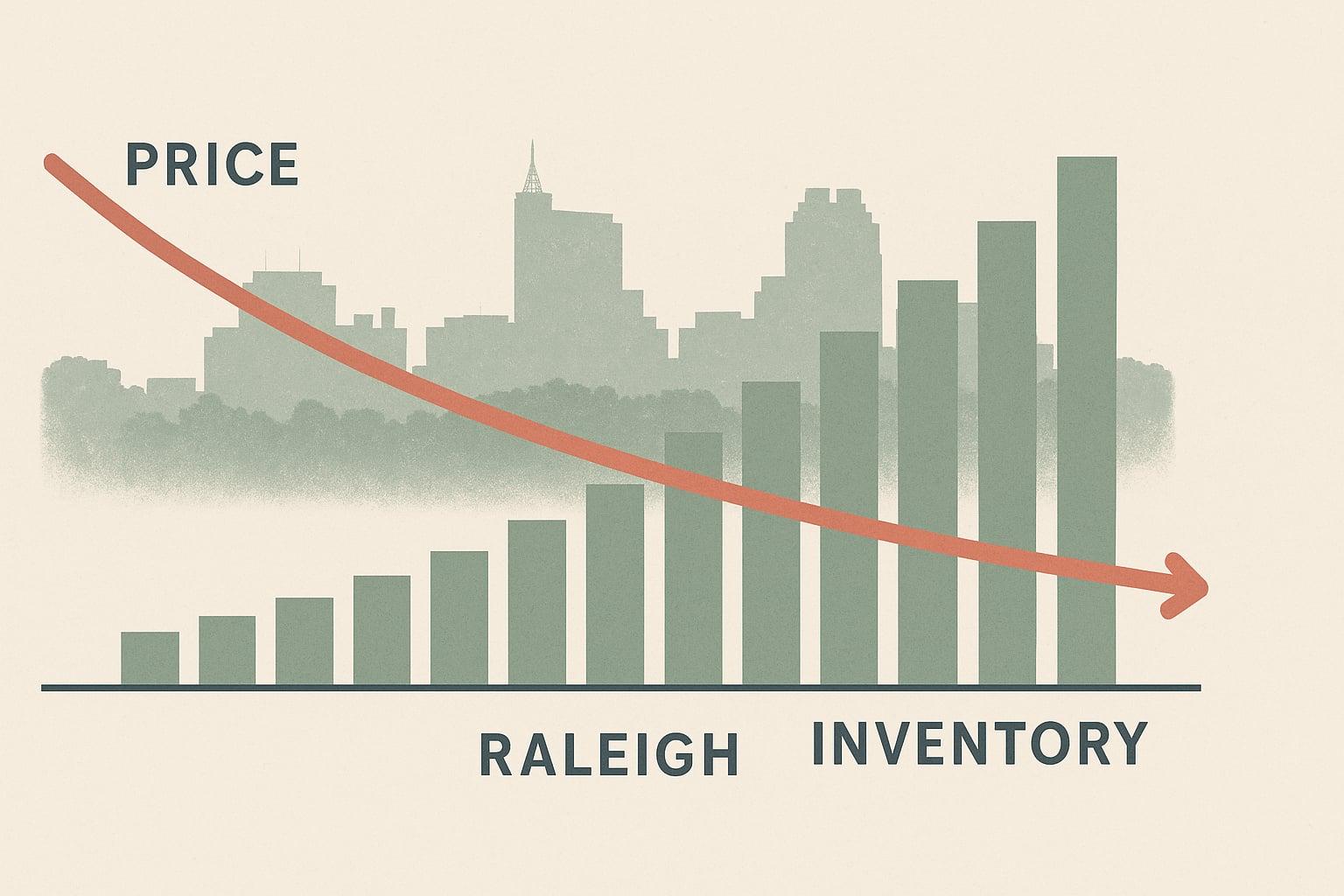
If you're weighing a move to Raleigh right now, mid-2026 has handed you something the market hasn't offered since before the pandemic: room to negotiate.
The numbers backing that up are worth walking through carefully, because they tell a more nuanced story than either "crash" or "still hot."
Prices Are Softening — and Two Independent Sources Agree
Zillow's Home Value Index put the average Raleigh home at $436,056 as of June 2026, down 2.1% year-over-year. Redfin's parallel data for the three months ending May 2026 shows a median sale price of approximately $425,000.
Two independent indices pointing the same direction is a meaningful signal. This is modest softening, not a collapse.
For context, the Realtor.com-sourced median listing price tracked via FRED's series for the Raleigh CBSA sat at $457,000 in June 2026. That $32,000 gap between what sellers are asking and what buyers are actually closing at, roughly 7%, is the clearest single measure of negotiation leverage in the market right now. In 2021 and 2022, that spread was effectively zero.
The Number That Matters: 34 to 43 Days
Homes in Raleigh averaged 34 days on market over the three months ending May 2026, per Redfin. Houzeo's March 2026 data puts the figure at 43 days on average.
That extra time matters because it changes the entire psychology of a transaction. Days on market stretching doesn't mean homes aren't selling; it means sellers are losing control of the timeline, and buyers have more time to think, negotiate, and structure smarter offers.
Above-Ask Activity Has Cooled — But the Market Isn't Broken
Houzeo's March 2026 data shows 21.2% of Raleigh homes sold above list price, down from 24.6% in March 2025. The sale-to-list ratio held at 98.44%.
That combination tells you something important: sellers on well-priced properties still retain pricing power. The market has shifted toward negotiated pricing, not distressed pricing. Raleigh remains supported by sustained buyer demand, strong homeowner equity levels, and stricter lending standards than pre-2008.
Roughly one-third of listings are reducing prices — not because the market is failing, but because the market is negotiating.
Inventory Is Up, But You're Not in a Buyer's Market Yet
Months of supply in Raleigh stood at 3.4 in March 2026, up from roughly 2.75 a year prior, per Houzeo. Inventory has risen meaningfully year-over-year across the broader Triangle.
That sounds like a lot — and relative to 2021–2023, it is. But a balanced market runs at 4 to 6 months of supply. At 3.4 months, Raleigh is still in seller-leaning territory overall.
If a home has been sitting for 40 or more days, you have real leverage to negotiate on price or terms. The caveat: the entry-level market under $350,000 is still competitive. Price and segment matter enormously in how much room you actually have.
The suburban picture diverges sharply from the city average. Nearly 49% of homes in Fuquay-Varina have undergone price adjustments in 2026, per MI Homes research, against a metro-wide rate of roughly 33%. Outer-ring inventory built ahead of demand; closer-in neighborhoods are tighter.
Why the Floor Is Holding
Raleigh's price correction has a built-in brake: sustained in-migration. U.S. Census Bureau 2025 Vintage estimates released in January 2026 show North Carolina led all states in domestic in-migration with approximately 84,000 net movers. "North Carolina's secret is out," Governor Josh Stein said when the estimates were released. "Our strong economic growth, natural beauty, and good people are attracting others from around the country."
That demand pipeline doesn't vanish overnight. BLS data via FRED shows Raleigh's unemployment rate near 3%, and the FHFA House Price Index for the Raleigh-Cary MSA is up modestly, about 1.1% year-over-year as of Q2 2026, suggesting the broad price structure is more stable than the headline softening implies.
The Census Bureau also shows Raleigh's metro population growing around 2% year-over-year, one of the stronger rates among major Sun Belt metros — and those arrivals are the cohort you'll be competing with if you wait too long. New private housing permits for the Raleigh-Cary area have continued at a significant pace per Census Bureau data via FRED, so supply additions are ongoing — but the pace hasn't yet outrun demand.
Your Offer Strategy for Mid-2026
Here's what all of this adds up to for an active relocator.
The $457,000 median list price versus the ~$425,000 median close tells you sellers are still anchoring high. Your opening offer has room. Sellers are accepting contingencies again — home inspection contingencies, appraisal contingencies, and requests for closing cost credits are back on the table in many transactions. Ask for them.
Focus your search on homes that have been sitting 40 or more days. Fuquay-Varina and other outer suburbs have the highest concentration of motivated sellers. If your budget stretches past $350,000 and you have flexibility on neighborhood, your leverage is real.
One rate note: the 30-year fixed is currently in the mid-to-upper 6% range. That shapes your monthly payment math more than a 2% price move does. Run the numbers on your specific purchase price before anchoring to a headline figure. Check the Raleigh housing market data and the broader Raleigh cost-of-living breakdown to stress-test your budget before you make an offer.
The window where you have both inventory choice and negotiation leverage is open right now. It won't stay that way forever — not with 84,000 net new North Carolinians arriving annually.
This article was researched and drafted with AI assistance, fact-checked, and reviewed by an editor before publication — see our Editorial Standards. It is general information about real estate markets, not financial, investment, legal, or real estate advice; consult a licensed professional before acting. See our full disclosure.
More market analysis
Phoenix Days on Market Surges 55% Year-Over-Year: April 2026 Analysis
5 min read
Austin and Tampa: Housing Supply Rises Above Balanced-Market Norms — What the Sun Belt's Deep Buyer Markets Mean for 2026
7 min read
Nashville's Inventory Explosion: Active Listings Up 193% — What a 5.6-Month Supply Means for Buyers and Sellers in 2026
6 min read
Considering a move? Explore the full Raleigh market data — home prices, rents, jobs, permits, and population trends.
Beyond the calculator: see our full relocation toolkit — movers, agents, insurance, and city-test rentals.