Houston vs. Dallas Cost of Living 2026: Jobs, Insurance, and What Relocators Actually Pay
Compare Dallas-Fort Worth vs Houston side by side
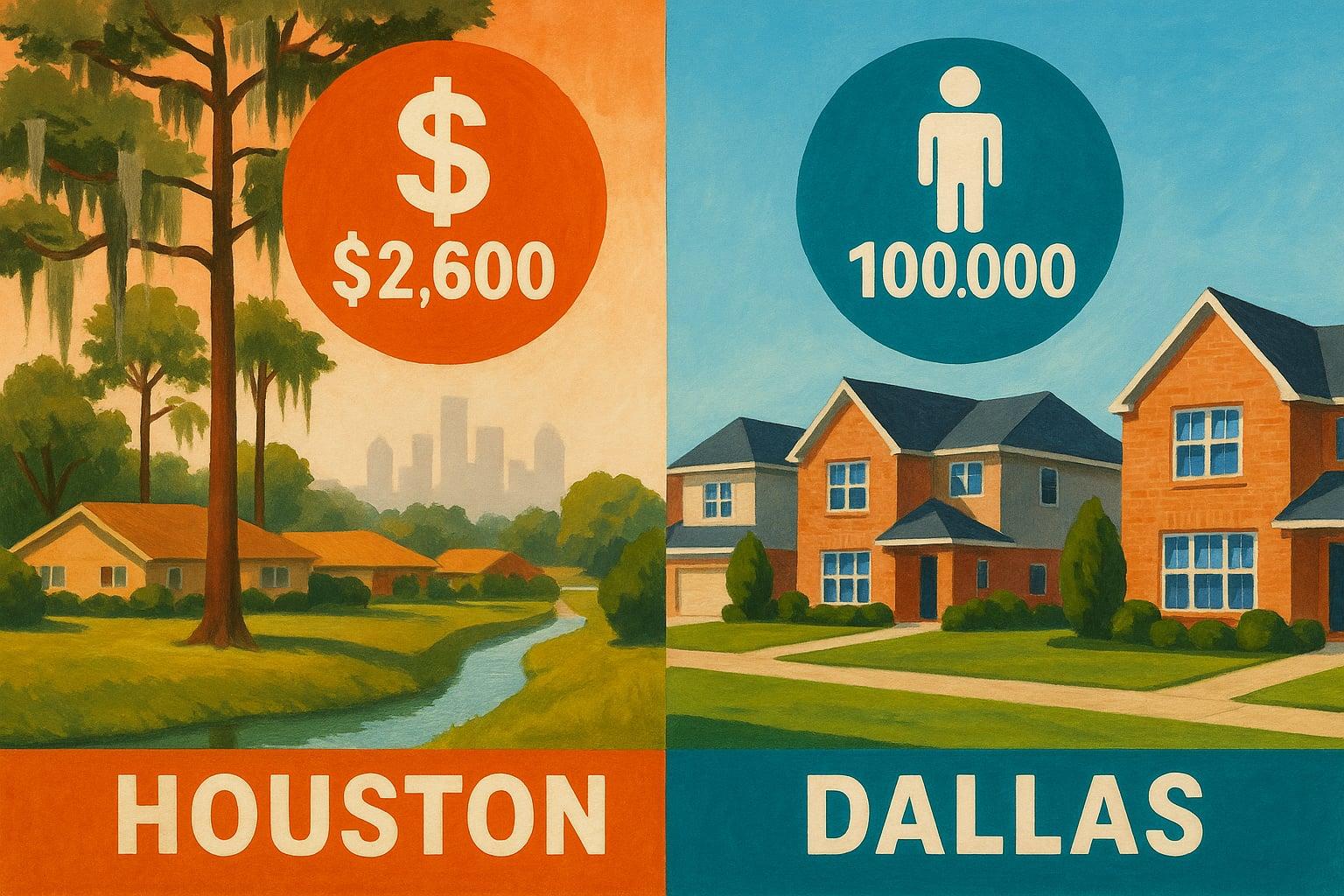
If you're choosing between Houston and Dallas in 2026, the headline cost-of-living gap is smaller than most articles suggest — and the insurance bill will surprise you either way.
Most comparisons stop at housing prices. This one doesn't. Stack in jobs, unemployment risk, insurance, property taxes, and rent, and a very different picture emerges of which city costs more to actually live in.
The Job Market: Dallas Leads, Houston Surprises
Houston created 39,700 jobs in fiscal year 2025–26, ranking third among major U.S. metro areas for job growth over the past year, even as the region's unemployment rate climbed above both the state and national averages — trailing only New York (69,100 jobs) and Dallas (54,600), according to the Greater Houston Partnership's midyear economic update.
That's an impressive headline. The catch is underneath it.
Houston's unemployment rate climbed to 5.2% as of June 2026, above both the Texas and national averages, per BLS Local Area Unemployment Statistics data. Dallas's unemployment rate is modestly lower than Houston's 5.2%, though both metros now exceed the national average.
Colin Baker, the Greater Houston Partnership's manager of economic research, noted that Houston accounted for about 8% of the nation's job growth over the past 12 months. Strong, yes — but a rising unemployment rate alongside job creation often signals that the labor force is growing faster than employers can absorb it, making competition for open roles stiffer.
Arts and recreation, real estate, oil and gas extraction, and finance and insurance all saw job declines in Houston over the past year, according to the Partnership's update. Dallas's growth is broader across sectors. Per the Dallas Fed's July 17, 2026 employment forecast, Dallas posted 3.7% year-to-date payroll growth against Houston's 2.7%, figures that reflect payroll expansion through June 2026 and are distinct from the GHP's fiscal-year job-count totals cited above.
For relocators with healthcare, professional services, or construction backgrounds, both metros have openings. For everyone else, Dallas's unemployment rate remains below Houston's, though both metros now sit above the national average — meaning neither is a low-risk landing spot for relocators without an offer in hand.
The Number That Actually Moves the Decision
Home insurance.
According to NerdWallet's 2026 homeowners insurance cost analysis, Houston homeowners pay $7,855 per year and Dallas homeowners pay $5,890 per year (NerdWallet city-level average, $400,000 dwelling coverage). The national average is approximately $2,490. Note that figures vary by source and policy structure — NerdWallet's own Texas-specific analysis using a different rate base shows higher figures for both cities. Actual premiums vary by coverage level, carrier, and property.
Houston's premium runs more than three times the national average. That's a structural line item that reshapes total cost of ownership, not a rounding error you can negotiate away. The annual gap between the two metros alone is nearly $2,000. If you want to understand why Houston's premiums are so high, the Houston flood zones and hurricane season buyer guide walks through FEMA flood zone exposure zone by zone.
For more on how Texas insurance costs compare across the state, the Texas homestead exemption and property tax relief guide puts both metros in full context.
Mortgage, Taxes, and the Monthly Bill
At a Houston median of approximately $344,000 versus Dallas's approximately $417,000 (Redfin, July 2026), the purchase price gap is meaningful before you factor in anything else.
At the current 30-year fixed rate of 6.66% per Freddie Mac's survey for the week ending August 27, 2026, a 20% down payment on a Houston median home carries a meaningfully lower principal-and-interest payment than the Dallas equivalent.
Property taxes narrow the gap. Harris County carries an effective property tax rate of approximately 2.0%, while Dallas County runs approximately 2.23% — close enough that the higher Dallas purchase price still produces a larger dollar-amount tax bill in most scenarios.
Texas softens both bills with its homestead exemption. Texas homeowners who use their property as a primary residence can exempt $140,000 of their home's market value from school district property taxes (Texas Tax Code §11.13, 2026 tax year). You apply once through your county appraisal district at no cost, and the exemption stays active until you move. File it as soon as you close — filing by April 30 of the tax year is the cleanest path, though Texas Tax Code §11.431 allows retroactive applications for up to two prior tax years if you miss that window.
For renters, the gap is real. HUD Fair Market Rent data puts a two-bedroom in Dallas at $1,931 per month (HUD FY2026), while Houston's metro-wide FMR runs meaningfully lower, a difference that adds up quickly while you're waiting to buy.
Six Dimensions, Side by Side
| Metric | Houston | Dallas |
|---|---|---|
| Jobs added (FY 2025–26) | 39,700 | 54,600 |
| Unemployment rate | 5.2% (June 2026, BLS) | 4.7% (June 2026, prelim.; BLS) |
| Median home price (approx.) | ~$344K (Redfin, July 2026) | ~$417K (Redfin, July 2026) |
| Effective property tax rate (est.) | ~2.0% (est., Harris County / City of Houston) | ~2.23% (Dallas County) |
| Avg. homeowners insurance | $7,855/yr | $5,890/yr |
| HUD 2BR Fair Market Rent | Below $1,931/mo | $1,931/mo |
As of June 2026, both metro unemployment rates exceed the national average of 4.2% (seasonally adjusted, BLS June 2026).
Where the Two Metros Actually Land
Houston is cheaper to buy into and cheaper to rent in. Dallas is cheaper to insure and carries a lower unemployment rate. Neither city has a state income tax — that's the one line where both metros tie.
The Greater Houston Partnership's own update highlighted that Houston is creating jobs at roughly four times the pace of the rest of the country, a real claim. But within Texas, Dallas is growing faster than Houston on employment rate, and for a relocator whose first priority is landing a job, that distinction is the deciding one.
If you're moving with a job offer already signed, Houston's lower prices and rents make it the better buy. If you're relocating to search, start from Dallas. Either way, build insurance into your budget before you look at a single listing — both metros will cost you far more than the national average on that line.
Before you commit to either city, review the Houston flood zones and hurricane season buyer guide and the Texas homestead exemption and property tax relief guide to pressure-test your budget, then explore Houston and Dallas listings to compare current inventory and cost breakdowns for both metros.
This article was researched and drafted with AI assistance, fact-checked, and reviewed by an editor before publication — see our Editorial Standards. It is general information about real estate markets, not financial, investment, legal, or real estate advice; consult a licensed professional before acting. See our full disclosure.
More market analysis
Texas Just Cut Your Property Tax Bill: What Houston, Dallas, San Antonio, and Austin Homeowners Need to Know in 2026
4 min read
San Antonio Cost of Living 2026: The Most Affordable Major Texas Metro — By the Numbers
4 min read
Dallas-Fort Worth Tech Jobs 2026: 11,000 New Roles, $761M AI Investment, and What It Means for Relocators
4 min read
Beyond the calculator: see our full relocation toolkit — movers, agents, insurance, and city-test rentals.